
Photo by Thomas Koukas · Unsplash
When I was working the counter at a K-beauty shop in Vancouver, there was one question customers asked over and over, usually while pointing at the back of a sunscreen tube:
“This one’s SPF50 and PA++++ — higher numbers are better, right?”
What I found interesting is that everyone recognized the SPF and PA markings. They’d seen them plenty of times. But most people didn’t actually know what they meant — they just gravitated toward the biggest number with the most plus signs. The logic was basically “higher must block more,” even without knowing what was being blocked.
And honestly, that’s a fair instinct. But once you know what each of these numbers is actually protecting you from, it gets much easier to pick the sunscreen that fits your situation instead of just grabbing the highest number on the shelf. So today I’m going to break it down the same way I used to explain it at the counter: what does SPF and PA mean, what broad-spectrum means, and how to read those numbers when you’re choosing.
This post is for general information. Skin conditions and reactions vary from person to person, so if you have a specific skin concern, talking to a professional is always the most accurate route.
First, UV Rays — UVA and UVB Are Not the Same Thing
To understand the numbers on a sunscreen, you first have to know that UV isn’t one single thing. The UV that reaches your skin is broadly split into UVA and UVB.
- UVB → the type mainly associated with sunburn. It’s strongest in summer and in the middle of the day.
- UVA → penetrates deeper into the skin and is understood to be involved in photoaging and pigmentation. Because its wavelength is longer, it partially passes through window glass, and it varies less by season and time of day than UVB does.
There’s an easy way to remember it: A is for Aging, B is for Burning. Once you separate those two in your head, it becomes obvious why SPF and PA exist as two different measurements.
SPF — The Number Associated With UVB and Sunburn
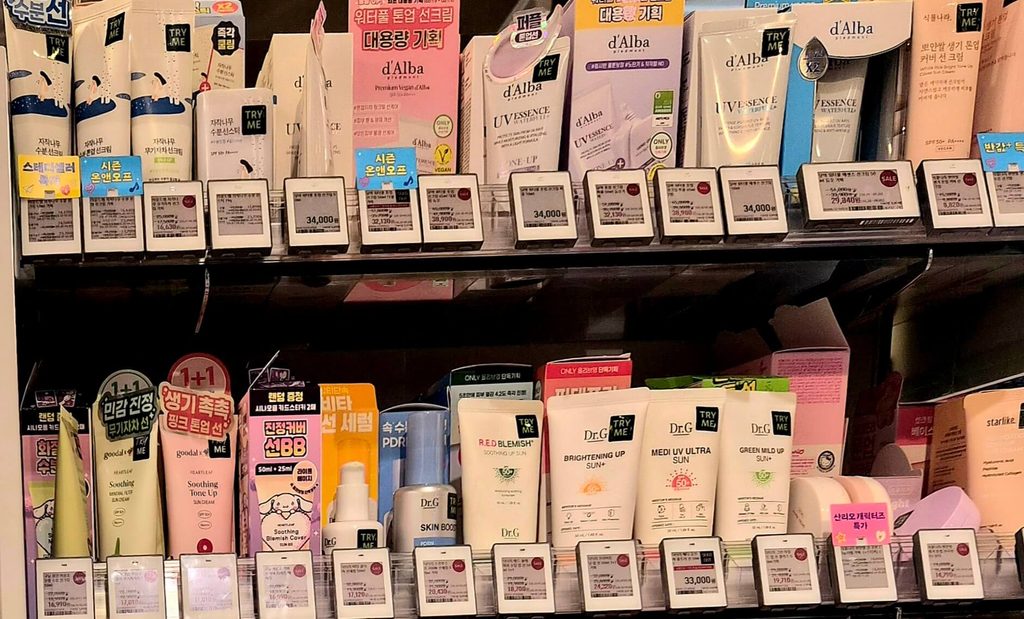
SPF stands for Sun Protection Factor, and it’s an indicator of how well a product protects against sunburn caused mainly by UVB. It’s the number we all know: SPF30, SPF50.
Here’s the most common misunderstanding. The SPF number is not a measure of time. It’s easy to assume something like “SPF15 means I last 15 times longer,” but SPF isn’t about time — it’s closer to a measure of how much is blocked.
According to the American Academy of Dermatology (AAD), SPF 30 blocks about 97% of UVB. And the blocking rate doesn’t climb in proportion to the number as it goes higher — plus, no sunscreen blocks 100%. A higher SPF also doesn’t last longer, so you need to reapply regardless of the number.
So think of SPF as an answer to “how much UVB is being blocked,” not “for how long.”
PA — The Grade That Shows UVA Protection
Photo by Amplitude Magazin · Unsplash
So what tells you about UVA? That’s PA.
PA stands for Protection Grade of UVA, and it’s a rating for the level of UVA protection a sunscreen provides. You’ll see it often on sunscreens from Korea, Japan, and elsewhere in Asia.
It’s usually marked like this:
- PA+ → low UVA protection
- PA++ → moderate
- PA+++ → high
- PA++++ → very high
More plus signs means more UVA protection. PA is used mainly in Asian markets — North American sunscreens instead tend to indicate UVA and UVB protection with the broad-spectrum label I’ll explain next.
So What Does “Broad-Spectrum” Mean?
Just because a North American product doesn’t have a PA rating doesn’t mean it isn’t protecting you from UVA. It uses the label “broad-spectrum” instead.
Broad-spectrum means the product provides protection against both UVA and UVB. Health Canada also recommends a broad-spectrum product with SPF 30 or higher as a baseline. Here’s how the two labeling systems compare:
- Products from Korea, Japan, and other Asian markets: often show the level of UVA protection with a PA grade alongside the SPF.
- North American products: you check for UVA and UVB protection through the broad-spectrum label.
The labeling differs, but both are designed to help you identify products that provide UVA protection, not just UVB protection. That’s exactly why, when you’re shopping for sunscreen, you shouldn’t stop at the SPF number — you also want to look for a PA grade or a broad-spectrum label.
SPF vs. PA: How to Choose the Right Numbers.
Here’s the guideline I gave most often at the counter:
- For everyday use: broad-spectrum (or something with a PA marking) at SPF 30 or higher is generally fine for daily life.
- For strong sun or long stretches outdoors: you might consider a higher SPF and a higher PA (say, PA+++ to ++++).
But how long is long, and how strong is strong before you need the 50? That’s hard to pin down. Because the line is so fuzzy, a lot of people end up defaulting to “just buy the highest one.” I completely get the impulse. But as we saw, the difference between SPF 30 (about 97%) and anything above it is smaller than you’d think. So rather than picking based on the single highest SPF number, it matters far more in practice to check for broad-spectrum or adequate UVA protection, and to apply enough of it and reapply when you need to. (I covered how much sunscreen to use and how to apply it in detail in my post on how to apply sunscreen properly.)
And if you’re torn between mineral and chemical formulas, take a look at my mineral vs. chemical sunscreen post too.
Common Misconceptions, Cleared Up
“Isn’t a higher SPF way safer?” → The blocking rate doesn’t rise in proportion to the number. The gap between SPF 30 (about 97%) and anything higher is smaller than you’d expect.
“If the SPF is high, I’m covered, right?” → SPF mainly indicates the level of protection against sunburn caused by UVB. To also cover UVA — the type associated with aging and pigmentation — you need to check for a PA grade or a broad-spectrum label.
“If there’s no PA marking, does that mean no UVA protection?” → No. North American products indicate UVA protection with broad-spectrum instead of PA. It’s purely a difference in labeling.
“Doesn’t the SPF number tell me how many hours it lasts?” → No. SPF is closer to a measure of how much UVB is blocked, not time — and even a high number needs reapplying.
The Takeaway
The numbers on your sunscreen are simpler than they look.
- SPF = an indicator of protection against sunburn caused mainly by UVB
- PA = a grade showing the level of UVA protection (Asian labeling)
- broad-spectrum = protection against both UVA and UVB (North American labeling)
The point isn’t to win a numbers race. It’s to confirm you have protection against both UVA and UVB, apply enough of it, and reapply when you need to. Rather than fixating on the SPF number alone, the more useful habit is also checking for broad-spectrum or an appropriate UVA protection marking.