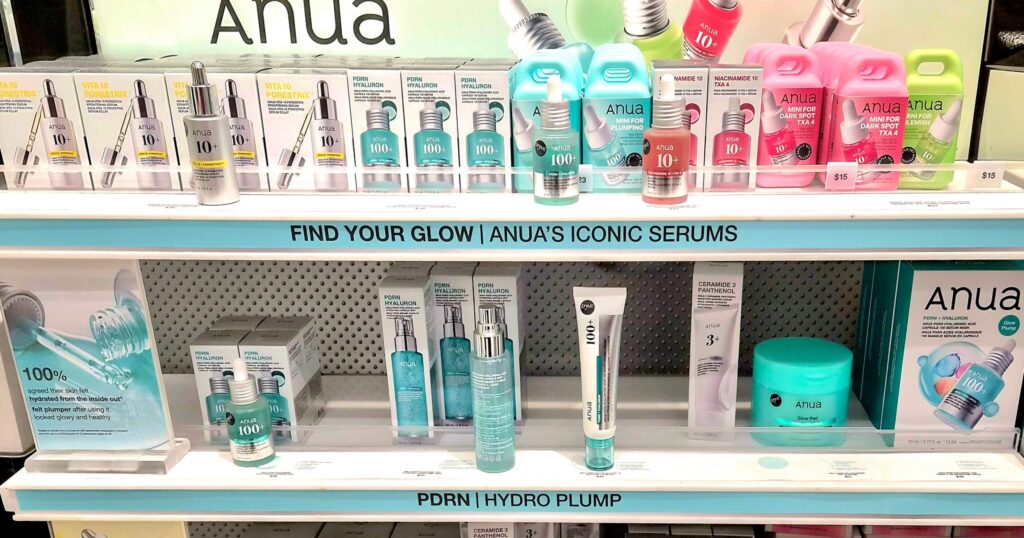
These days it’s almost harder to find a K-beauty product without PDRN than with it. Toners, serums, ampoules, creams — it’s everywhere. I studied esthetics, I’ve recommended this ingredient to customers on the sales floor, and — most importantly — I’ve used it myself for a long time. So today I want to lay it all out honestly: what PDRN actually is, the myths and truths around whether it really works, and the specific products that gave me real results.
What Is PDRN in Skincare?
PDRN stands for “polydeoxyribonucleotide.” The name sounds intimidating, but the concept is simple: it’s an ingredient typically extracted from salmon (or trout) DNA. That’s why you’ll also see it called “salmon DNA” or “salmon PDRN.” (These days you’ll also find plant-derived versions made from ginseng, rice, or yeast.) On ingredient lists, it’s usually labeled as Sodium DNA.
The reason this ingredient gets so much attention is its potential for skin regeneration and anti-aging:
- Helps support the recovery of damaged skin
- Supports collagen production and elasticity
- May help improve hydration, texture, and tone
- Plays a role in building up the skin barrier
PDRN has a long history of use in medical and in-clinic procedures, so it’s a well-established, well-studied ingredient from a safety standpoint — which is a big part of why it spread into skincare so quickly.
Does PDRN Actually Work? (The Myths and the Truths)

Photo by Fulvio Ciccolo · Unsplash
This is the part that really matters. PDRN is popular, but it’s also controversial — so let’s go through the facts.
Truth #1 — PDRN molecules are large. PDRN is a fairly big, heavy molecule. Skin, by design, is a barrier that doesn’t easily let large molecules (generally over about 500 daltons) pass through — and PDRN is far bigger than that (in the thousands to tens of thousands of daltons). That’s why some experts point out that on healthy, intact skin, simply applying PDRN topically doesn’t mean it’s easily absorbed.
Truth #2 — that’s exactly why formulation matters so much. Well-formulated PDRN products work around this absorption problem with methods like:
- Encapsulation, wrapping the PDRN in a delivery system that carries it into the skin
- Low-molecular-weight processing (breaking it down enzymatically) to improve absorption
In other words, the key is choosing a product where the PDRN has been broken down into smaller molecules and paired with a well-designed delivery system. Even with the same ingredient, results can vary a lot from product to product.
Truth #3 — PDRN may actually absorb better into a compromised barrier. Some experts believe that when the skin barrier is weakened or dehydrated — meaning there are more “gaps” in the barrier — PDRN can penetrate relatively more easily. That’s why people with dry, sensitive skin, or a compromised skin barrier tend to notice the effects more.
Bottom line: PDRN isn’t an ineffective ingredient. But instead of expecting dramatic overnight change, choose a product with low-molecular-weight PDRN and solid delivery technology, and use it consistently — that’s when you’re likely to see gradual improvements in hydration, texture, and elasticity. And honestly, the fact that it sparks this much debate is proof of just how popular it’s become.
So Who Is PDRN Good For?

Photo by Christian Agbede · Unsplash
- People with a weak, dry skin barrier — helps with soothing, hydration, and recovery
- Anyone focused on regeneration and elasticity concerns
- Mature skin that needs extra support for firmness and texture
On the flip side, if your skin is already strong and produces plenty of oil on its own, I wouldn’t pin all my hopes on PDRN alone — nailing the basics of your routine should come first.
Products I’ve Personally Tried and Recommend

Photo by Maria Lupan · Unsplash
Here are the ones I’ve recommended to customers in-store and genuinely loved using myself.
- Anua PDRN Hyaluronic Acid Capsule 100 Serum — This is my all-time favorite. It delivers such solid deep hydration that after I switched to it, a friend randomly asked, “Did you change your skincare?” I’ve recommended it to coworkers and customers too, and so many of them came back saying how much they loved it.
- VT PDRN Toner — The toner I’m currently using. Gentle enough for daily use.
- VT Cosmetics PDRN Essence 100 — This one worked especially well for people with a compromised barrier, dry skin, or more mature skin — it left their skin noticeably more hydrated.
- Medicube PDRN Pink Peptide line — The trendy “pink line” that’s been getting a lot of buzz lately.
Of course, everyone’s skin is different, so finding what actually works for you is always the most important part.
FAQ
Q. PDRN comes from salmon DNA — is it actually safe? Yes. PDRN has a long track record of safe use in medical and in-clinic treatments, and it’s now widely used in cosmetics too. That said, I’d still recommend patch-testing any new product on a small area first.
Q. Is the PDRN in skincare products the same as the PDRN used in clinic injections? The ingredient itself is similar, but the intensity of the effect is very different. Injectable/procedural PDRN is delivered directly into the skin, while topical skincare products face absorption limits — so it’s realistic to expect gradual improvement rather than injection-level results.
Final Thoughts
PDRN is genuinely a compelling ingredient, but it’s not a miracle worker. The key is choosing a product with small molecules and well-designed delivery, finding one that works for your skin, and using it consistently. Do that, and you can see real changes in hydration, texture, and elasticity — something I’ve confirmed both on my own skin and through countless customers.